
An agent can build almost anything you ask for now. What it can’t do is tell you whether the result is good. That part is still on you.
Every month LLMs get better at taking care of the technical difficulties. Code is not the differentiator anymore, taste is. It decides what you ask for, which of the five versions you keep, and when you stop iterating.
This lesson is all about taste and how to improve it.
Many people say that taste is just a personal preference. If that was true, then there would be no good and bad designs, just different personal preferences. Yet most people admire Apple’s products, and most agree that da Vinci was a great artist.
If taste is just personal preference,
then everyone’s taste is already perfect.
What actually happens is as you improve at any craft and revisit your old work, you realize that it’s not just different, it’s worse. And you can actually tell why!
That’s why I like showing good and bad examples next to each other. Put side by side, it’s easy to tell the difference, even if your taste is not developed yet.
Here’s why the one on the right feels better: it uses ease-out as the easing, which is fast at the beginning and helps it feel snappy. scale(0.95) feels better than scale(0) because nothing in the real world appears out of nothing. The duration is 200ms because a dropdown is used dozens of times a day, no need to slow the user down.
If you develop enough expertise in a certain topic, you’ll realize that almost every taste decision has a logical reason. Whether it’s code, design, writing, or baking bread.
As an example, a lot of people would say that animations are a matter of taste. You either get it or you don’t. But in animations.dev I explain why certain things work better than others, because there clearly is a reason. You just need to spend enough time to understand it.
When the first car came out, consumers didn’t care about its color or silhouette, because the competition was a horse. Now that cars are a commodity, quality and details matter more than ever.
The same applies to software. Shipping a working product is no longer enough, anyone can do that with AI. People expect things to work. What makes a product stand out is the brand, the design, the interactions, how intuitive it is. Taste is the differentiator.
In a world of scarcity, we treasure tools.
In a world of abundance, we treasure
taste.
AI makes this even more true. Left alone, an agent produces the average of everything it has seen. The average is fine, and fine is exactly what everyone else is shipping. Your taste is what pulls the output away from the average.
But taste in this context is not just how things look and feel, but also what type of decisions you make, your judgment. Deciding what features to build, what to prioritize, what to leave out, and even what product to build in the first place.
But how can you actually improve your taste?
You need to surround yourself with great work.
If you are a designer, study great designs. If you are a writer, read great books. Expose yourself to great work, this way you’ll learn what greatness looks and feels like.
It comes down to trying to expose yourself to the best things that humans have done and then try to bring those things into what you’re doing.
”Find people who are respected in their field. Look at who they admire and build a curated list of tastemakers. Look at their designs, use their apps, read their writing. The next lesson goes deeper into how to pick them.
Designers should copy great designs, writers should copy great books. Copy and re-implement work you admire until you can proudly create for yourself. Pay attention to the details, the small things that make a difference, especially now when everyone can build the same things.
Heavy exposure to great things shapes output.
While developing your taste, don’t just label things as good or bad. Instead of relying on gut feelings, try to rationalize why something feels great. Analyze and understand patterns.
If you’re a designer, don’t just use apps, study them. Why does this interaction feel good? If you’re a filmmaker, don’t just watch movies, think about why the director made the choices they did.
This matters even more when you work with AI, because “make it feel better” gives the agent nothing to work with. “The panel slides in too slowly and the text appears before the panel settles” does. The more precisely you can say why something works, the better the agent’s output gets.
And you can get that precision by developing your taste. Developing the eye to spot exactly what works and what doesn’t.
Here’s an example of this in action: I love recreating good animations, the ones that everyone talks about when they are first seen. There is always a reason why everyone talks about them and I want to find the why behind it. So I record the animation and scrub through the recording.
Oftentimes the animation happens quickly and you don’t see every detail of it, but trust me, the greatest animations have a lot of details. Scrubbing through the video helps you notice every single one.
I record a lot, even my own animations to see what I can improve.
This accelerated my learning more than anything else. I recorded an animation and recreated it until I was satisfied with my replica. It took a long time, but I learned so much from it.
Practice your craft. Create things. A designer should design, a writer should write. This will make you a good judge of taste, and with time, a tastemaker.
This is the most important step. You can’t learn to build great interfaces by watching someone else do it, just like you can’t learn to play guitar by watching someone else play. I show you my approach, but you need to put in the work.
There is a trap here that didn’t exist before. When an agent builds everything for you, it’s easy to skip the practice entirely. You accept whatever comes back because it looks fine. Don’t. Treat every result as a chance to train your eye. Ask yourself what you would change and why, before you ask the agent to change it.
While practicing, seek feedback from others. Good critique from the right person beats trial and error alone. The course’s Discord server is a great place to get it.
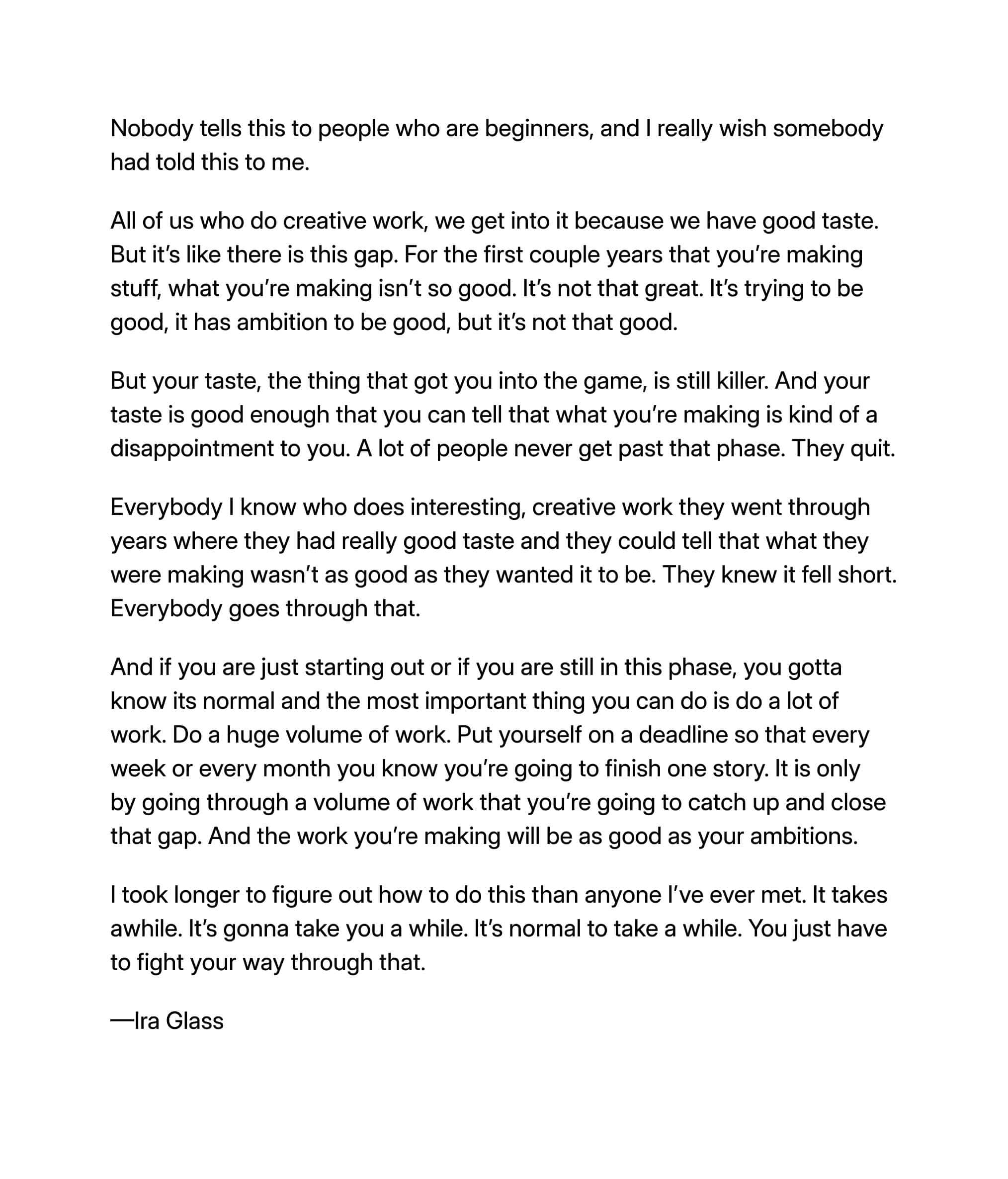
The things you create probably won’t be good at first, but that’s a good sign. Your taste is good enough to tell that your work is not on par yet. That’s the taste gap Ira Glass talks about here:
Taste doesn’t matter much if you don’t care about your work. The best people at any craft are that good because they care. They go the extra mile and they don’t stop until they are truly satisfied with the result.
You can feel whether people cared about their product or not. Apple’s products are made with care, Linear is made with care. You feel it when you use them.
What we make testifies who we are.
People can sense care and can sense carelessness.
Find an interface or interaction that you really like and describe why you like it. Be specific. Don’t just say the easing is nice or the layout feels clean, but rather why it feels that way.
Write it down or share it on the Discord server, don’t just do it in your head. Once it’s written down, you’re halfway to a rule your agent can follow. That’s how most of my skills started.
This shouldn’t be something you do once for this homework. If you are serious about improving your taste, you should review great work from others a lot. I know how much it helped me, and I know it’ll do the same for you.